
Skip to main contentSkip to footer

I2C DMX Controller – IS3715

✅ DMX Characteristics:
– DMX512-A Protocol Compliant
– Sends All 512 Channels
– Synchronization Output Pin
– Update rate: 44 Hz

✅ I2C Characteristics:
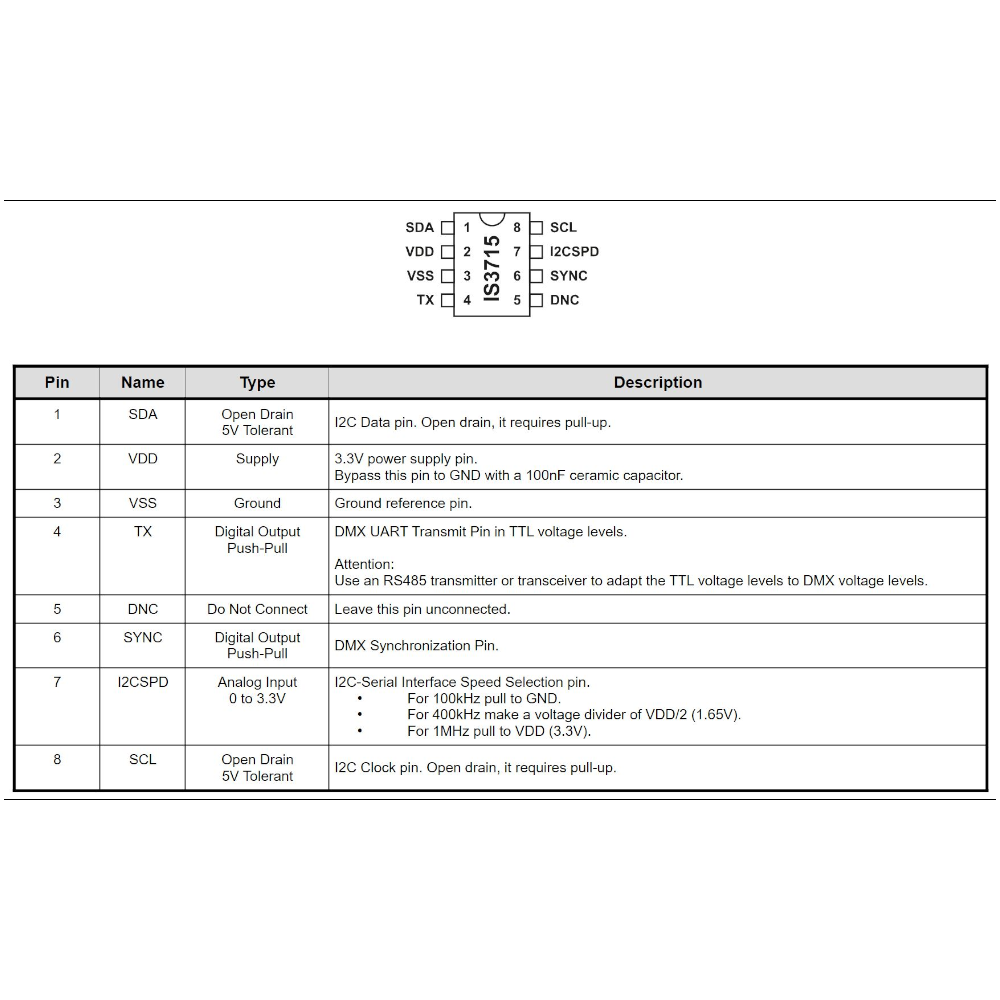
– I2C Slave Address: 21 (0x15)
– I2C Speed: 100 kHz, 400 kHz, 1 MHz
– I2C Voltage: 3.3 V (5 V tolerant)

Volume pricing

Qty.Price
1 - 9 1,95 
10 - 24 1,85 
25 - 99 1,70 
100 - 299 1,35 
300 - 499 1,23 
500 - 999 1,11 
1000 - 7999 1,03 
8000 + 0,98 
SKU: IS3715-S8

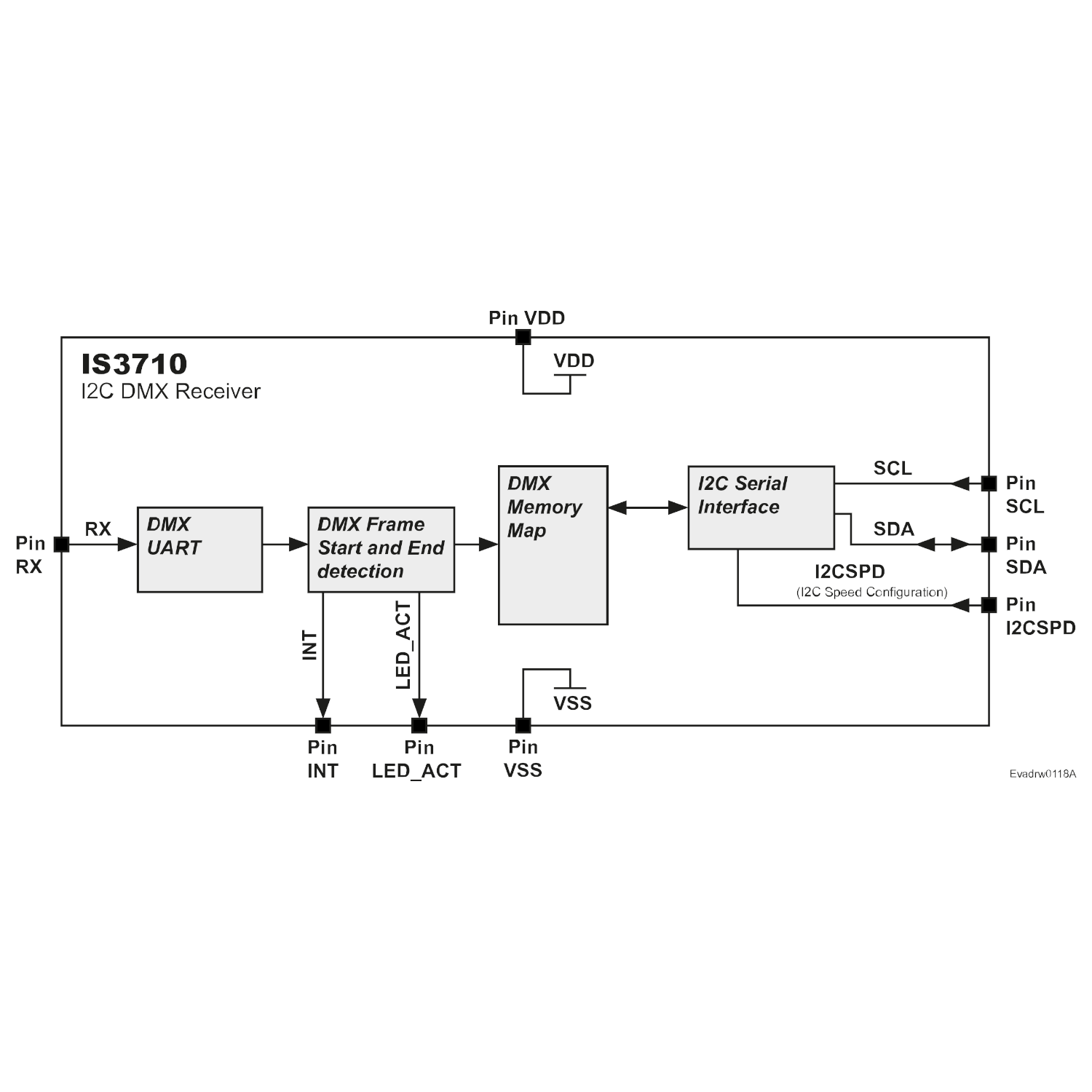
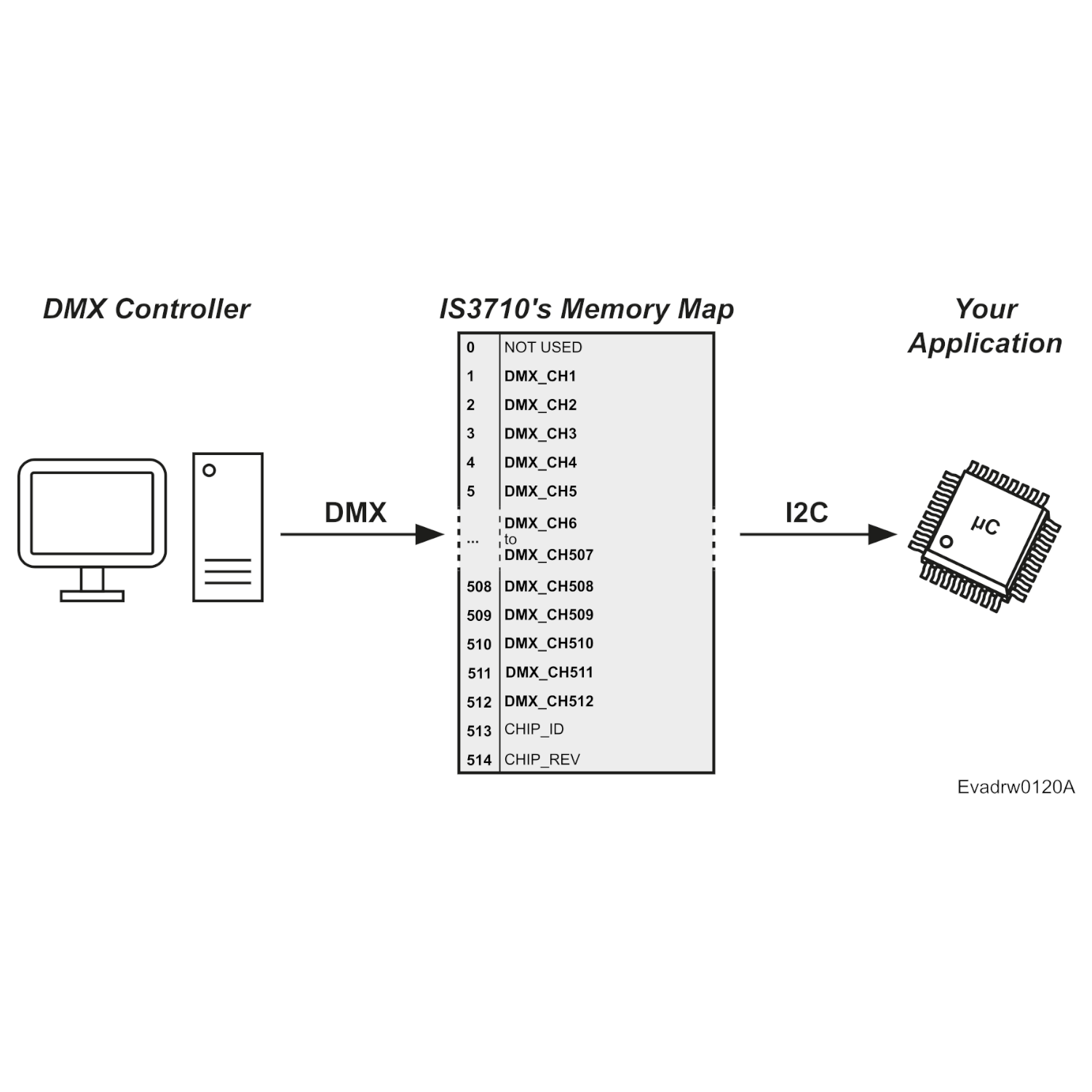
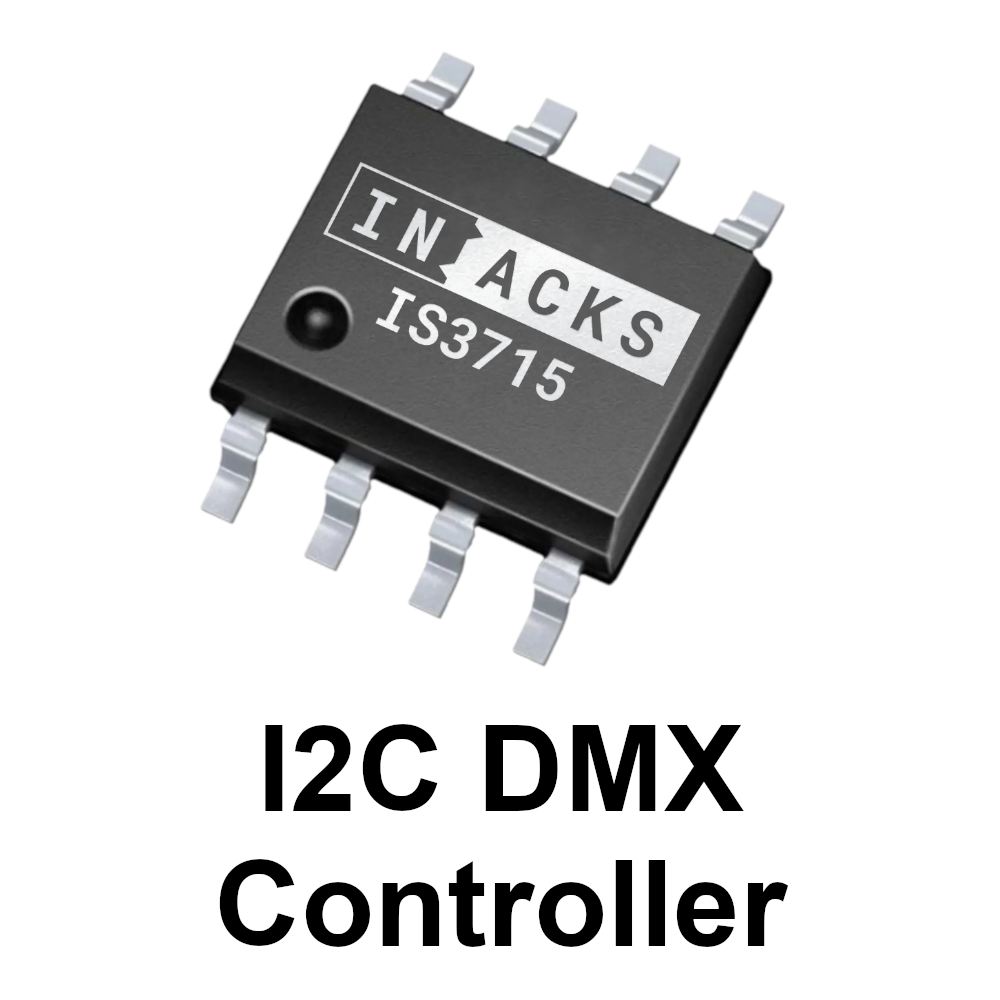
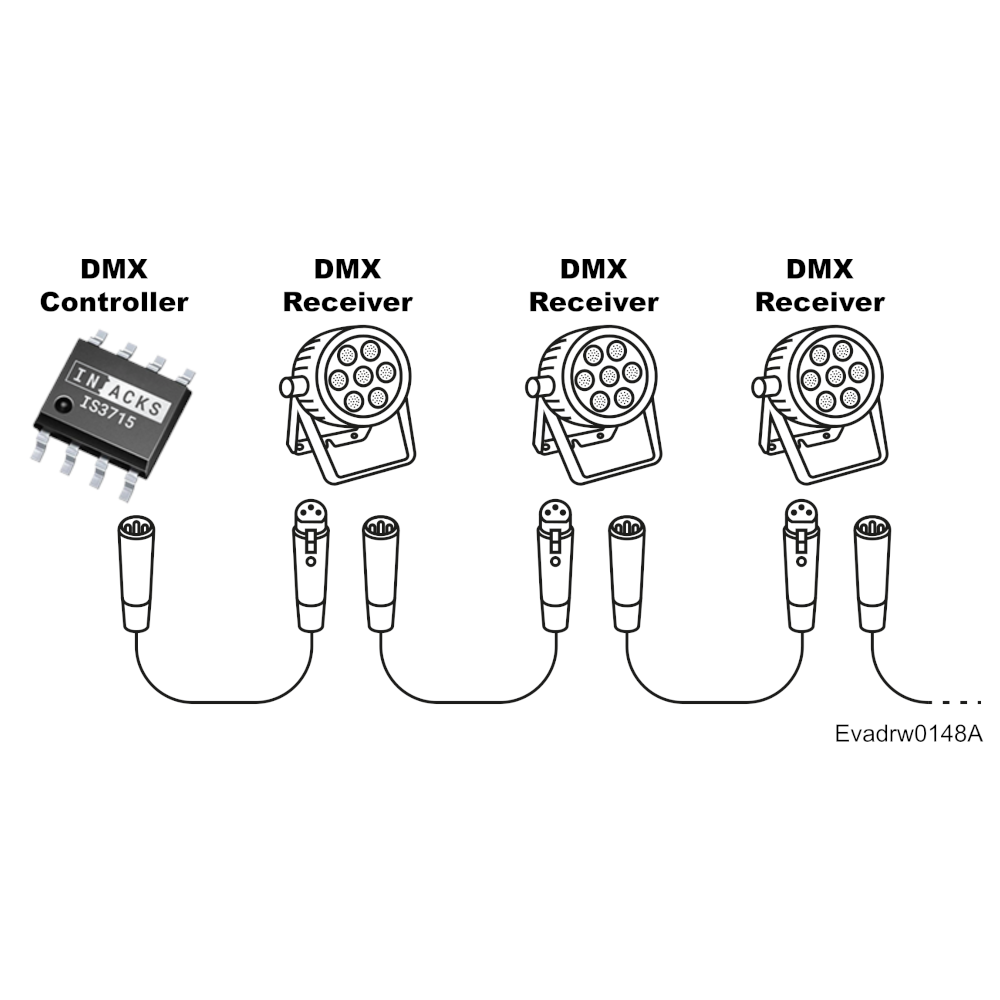
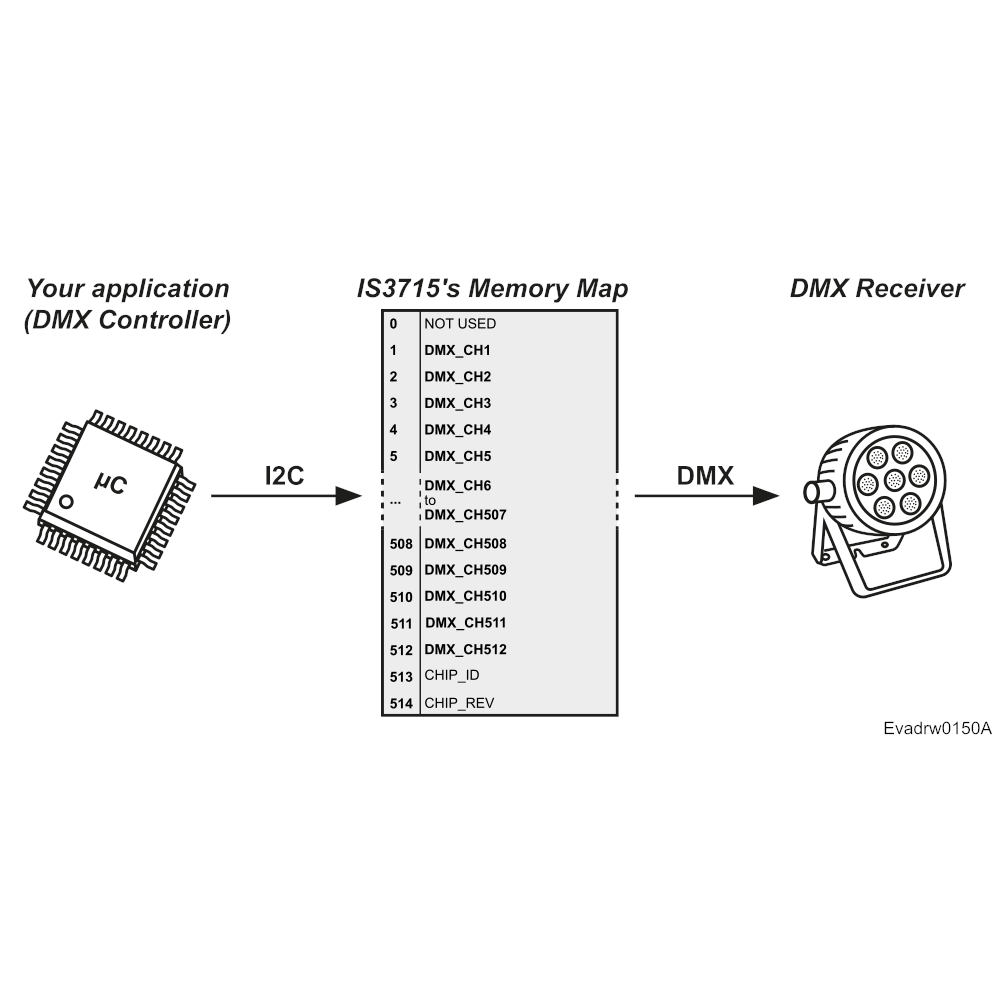
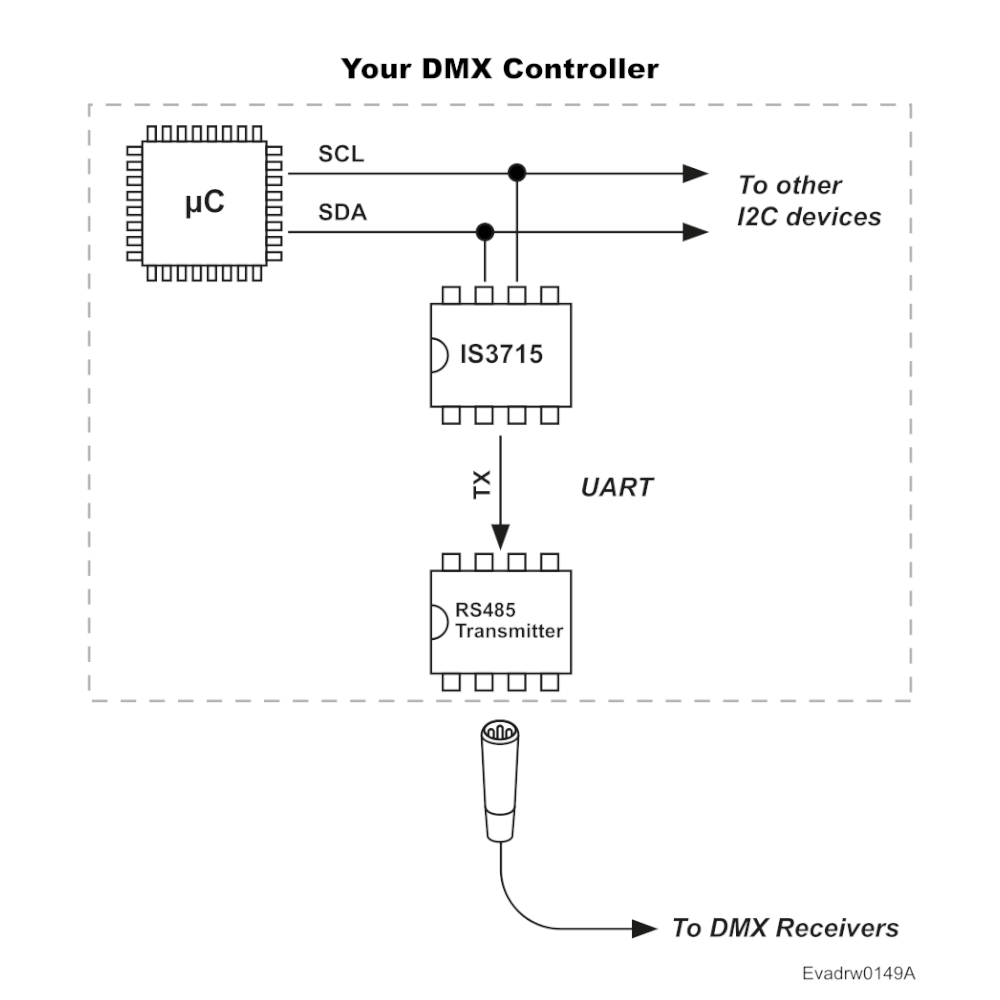
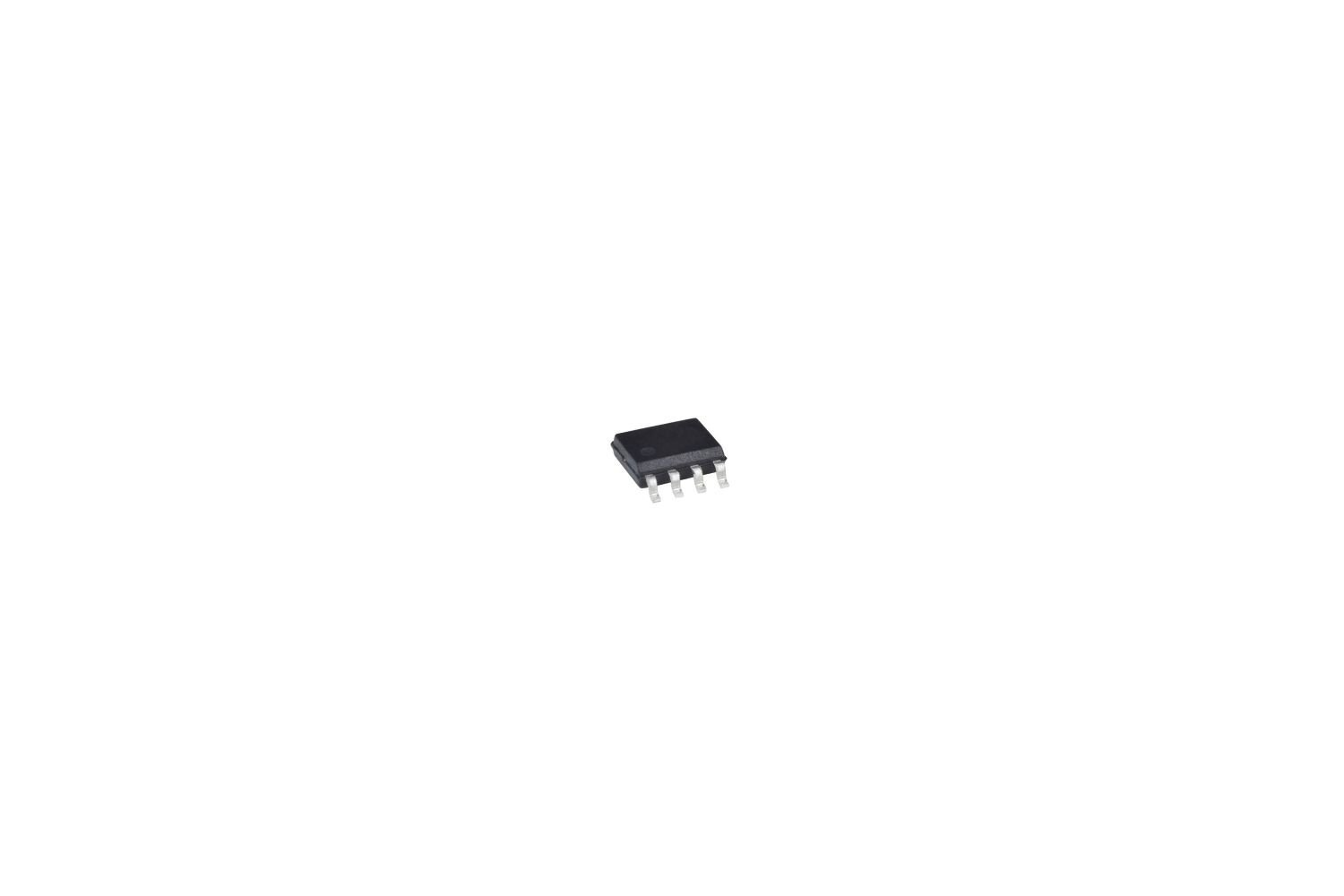
The IS3715 is an I2C DMX Controller chip. You write values to its internal memory map via I2C and it continuously outputs them as DMX data at 44 Hz.

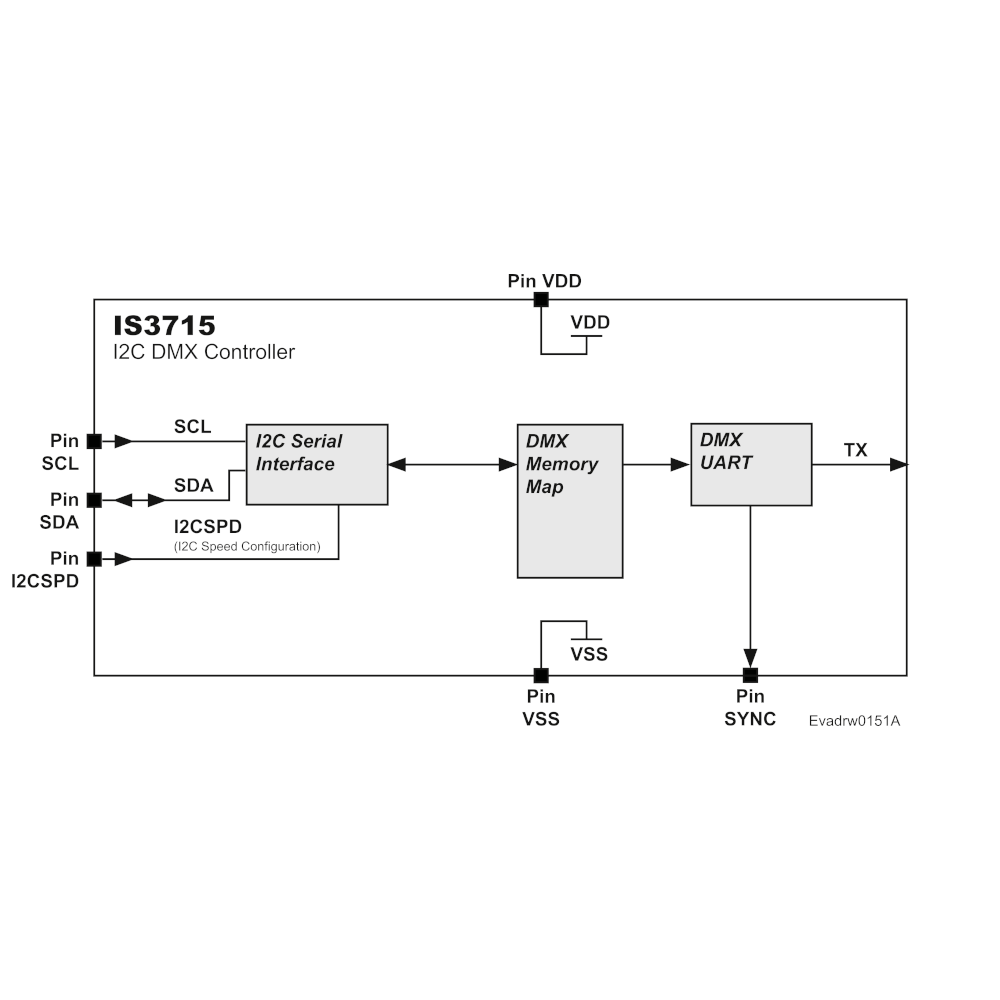
The chip features 512 8-bit RAM registers to store DMX channel values, which can be written to like a typical I2C EEPROM. It continuously outputs all memory as DMX data, so you only need to write via I2C when values change, keeping your microcontroller relaxed.

The I2C-Serial interface operates as a slave and supports 100 kHz, 400 kHz, and 1 MHz communication speeds.

The IS3715 frees your microcontroller from the DMX protocol timing constraints, memory requirements, and ISR load associated with generating DMX data, reducing the need for timers, flash, and RAM. It also eliminates the need for dedicated pins by operating over a shared I2C.

The device operates at 3.3 V, with 5 V-tolerant I2C, enabling compatibility with 3.3 V or 5 V microcontrollers. It is offered in Industrial (–40 °C to +85 °C) and Extended (–40 °C to +125 °C) temperature ranges.

*This company and the products provided herein are developed independently and are not affiliated with, endorsed by, or associated with any official protocol or standardization entity. All trademarks, names, and references to specific protocols remain the property of their respective owners.*
Documentation

Models

Examples

  • Please check the “Examples” tab on this page.


Q: How does the IS3715 work?
A: The IS3715 continuously sends all 512 DMX channels from the values stored in its memory map. You can write to the memory map registers via I2C according to the DMX channels and values you want to stream.

Q: Does the IS3715 require a specific DMX library or complex setup?
A: No. The primary benefit of the IS3715 DMX Controller Chip is its simplicity. It only requires standard I2C read functions—just like writing an EEPROM—to send DMX channel values, eliminating the need for specialized DMX libraries or complex timing setups.

Q: How many DMX channels does the IS3715 send?
A: All 512 DMX channels (a full DMX universe).

Q: How does the chip help reduce CPU usage?
A: The IS3715 handles the continuous DMX data stream and trimmer interrupts to generate the MbB and MaB, freeing your microcontroller from heavy ISR and processing load. You only need to write the required DMX data via I2C.

Q: How do I write the DMX data?
A: Via I2C. The device supports standard I2C speeds: 100 kHz, 400 kHz, and 1 MHz.

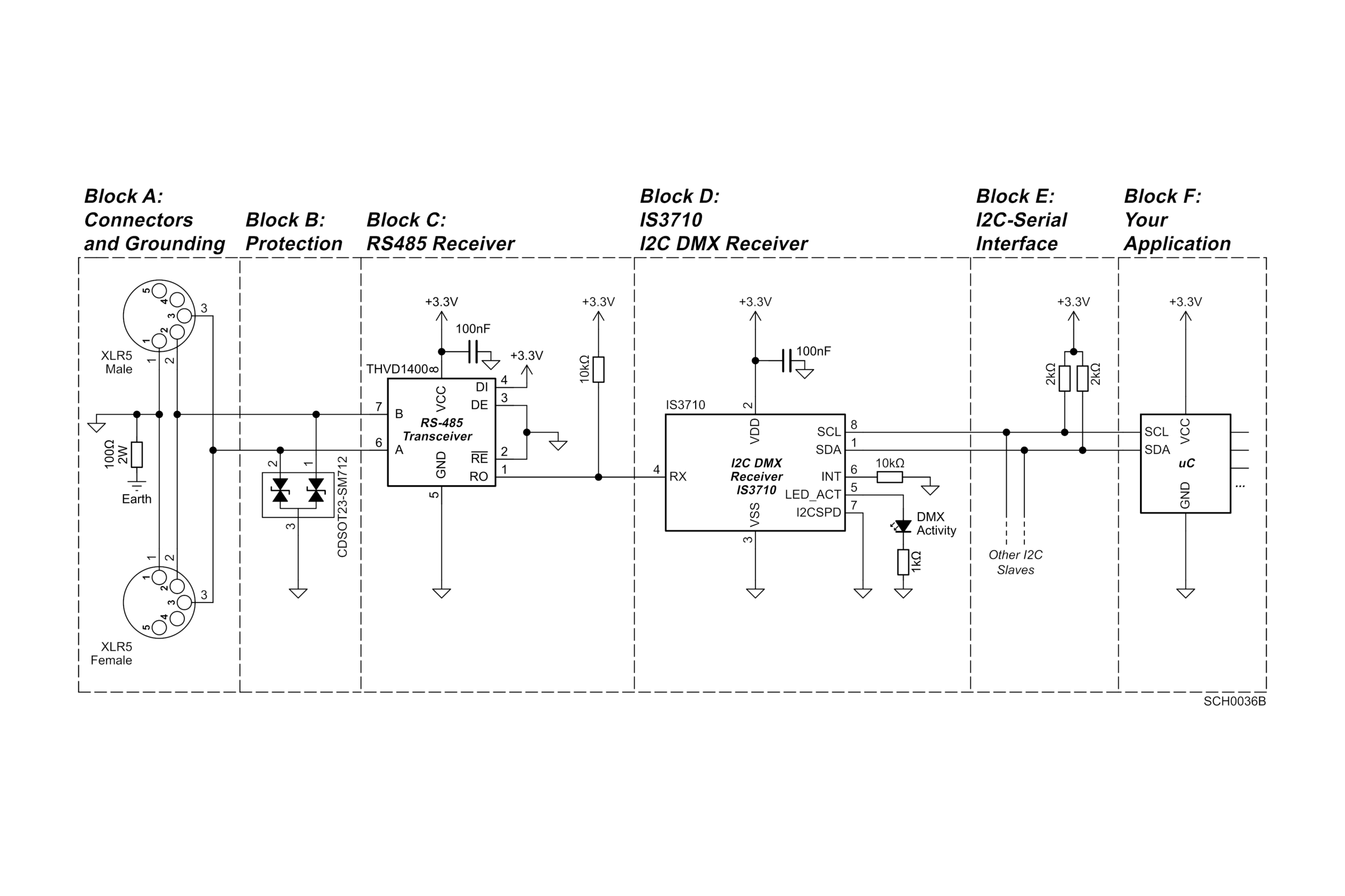
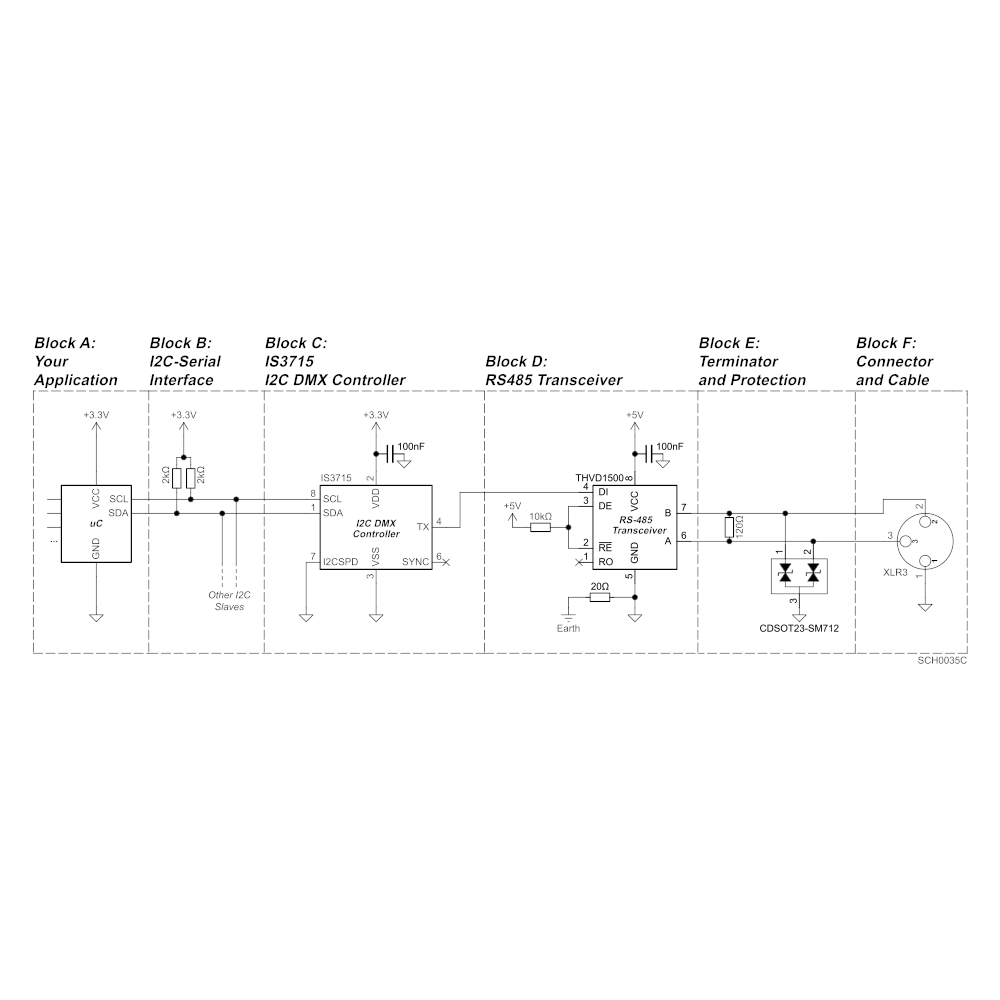
Q: Does the datasheet include a schematic example?
A: Yes. See the IS3715 datasheet or download the example.

Q: Do you have firmware examples?
A: Yes. See the Arduino example, the STM32 example, and Raspberry Pi example.

Q: Do you have evaluation boards?
A: Yes. We offer evaluation boards in the Arduino Uno form factor (Kappa3715Ard), which is also compatible with STM32 Nucleo, as well as a Raspberry Pi version (Kappa3715Rasp).

Q: In which products is the IS3715 typically used?
A: Custom lighting controllers, automated light controllers, digital art installations, architectural and building lighting, stage and entertainment lighting, animatronics, water fountains, OEM/device products, museum lighting, and more.

Q: Does the chip use an external RS485 transceiver?
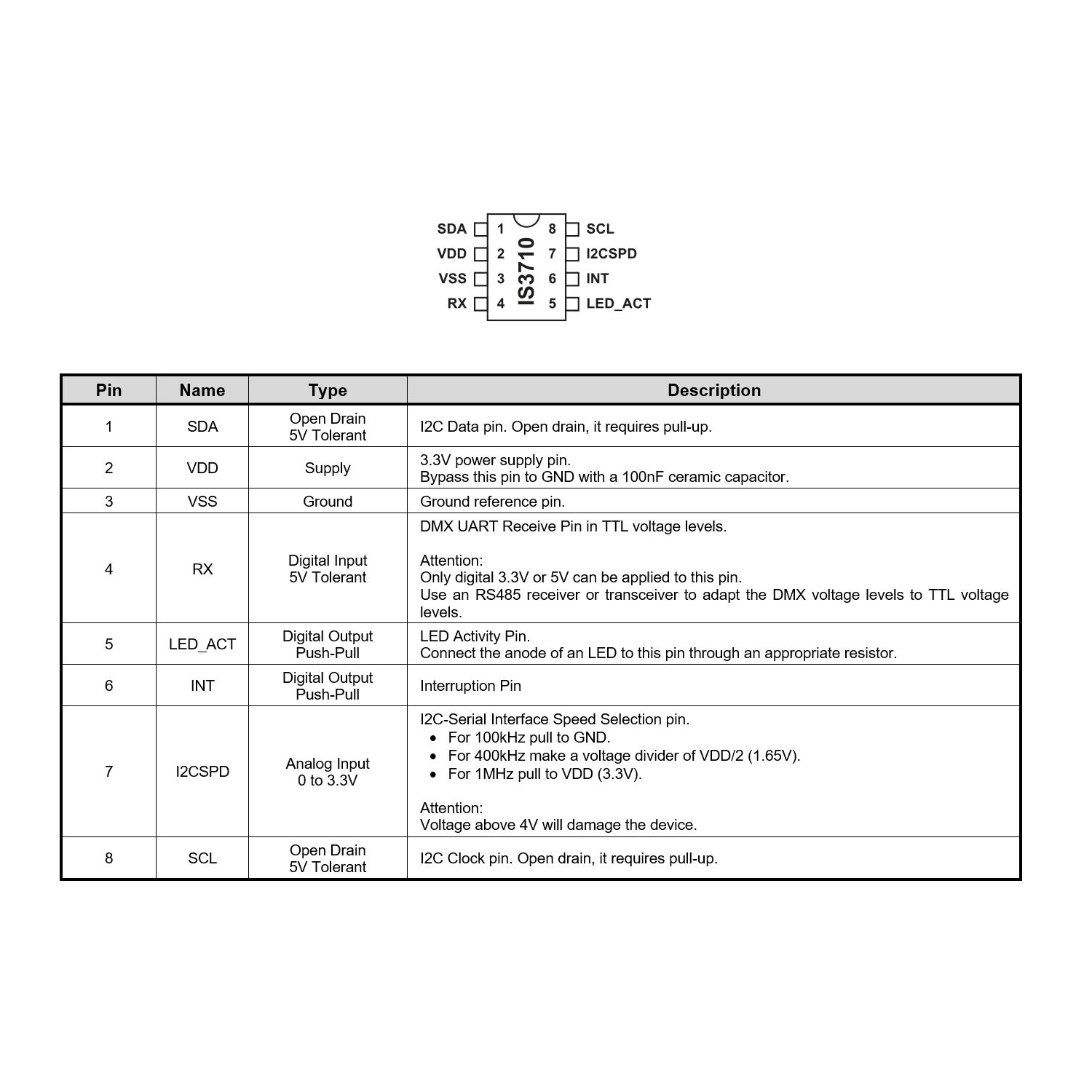
A: Yes. An external RS-485 transmitter or transceiver is required. Both 3.3 V and 5 V devices can be used. 5 V devices are recommended, as they offer better noise immunity and longer cable runs.

Q: But I need to control RDM as well as DMX.
A: Yes! For that, we offer a dedicated DMX+RDM receiver chip: the IS37205 I2C DMX+RDM Controller.

Q: Is there any demonstration video?
A: Yes, check it on Youtube.

Evaluation boards, Modules & other related products

Evaluation boards, modules, and accessories designed for fast prototyping and easy integration. Featuring standard interfaces and built-in transceivers, they simplify testing and development across platforms like Arduino, Nucleo, or Raspberry Pi. Ideal for adding RS485, RS232, or Ethernet functionality with minimal effort and maximum compatibility.

Have a question?

Fill out this field
Please enter a valid email address.
Fill out this field
You need to agree with the terms to proceed